
NASA’s Asteroid Collision Causes 6K-Mile-Long Tail Of Debris, Seen In New Image
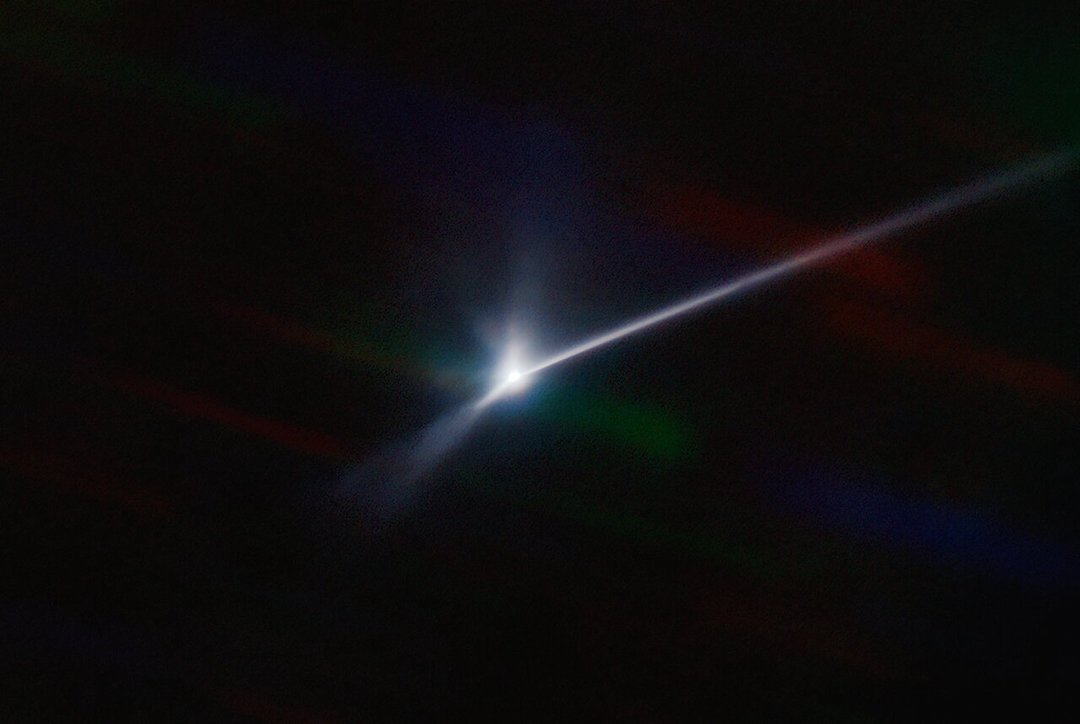
Last week, NASA launched its Double Asteroid Reaction Test (DART) satellite directly into the path of a meteor, Didymos, intending to knock its moonlet Dimorphos out of orbit in a test of planetary defense. Everything went successfully, and in the days that followed, a spacecraft that trailed behind the satellite captured stunning closeup images of the comet.
As the crash happened, three dozen telescopes watched the event go down from Earth, intent on tracking the moment of impact and helping the space agency determine if it successfully disrupted Dimorphos’ orbit.
New images depicting a trail of debris 6,000 miles long have been released. A team of researchers took the picture in Chile that used the Southern Astrophysical Research (SOAR) telescope to document the devastation left behind by DART.
Nailed it! The SOAR Telescope in Chile, operated by @NOIRLabastro, captured the more than 10,000 kilometers of trail left behind after @NASA's DART spacecraft hit Dimorphos.
— NOIRLab (@NOIRLabAstro) October 3, 2022
Credit: CTIO/NOIRLab/SOAR/NSF/AURA/T. Kareta (Lowell Observatory), M. Knight (US Naval Academy) pic.twitter.com/F9FUsELA55
The dust trail is known as the ejecta, debris pushed away by the Sun’s radiation pressure, just like a comet’s tail.
The Hubble and Webb telescopes were also trained to watch DART as it came in contact with the space rock. According to NASA’s Bill Nelson, this was the first time both had captured the same imagery out in the cosmos.
The pictures are crucial for NASA to study and examine the project’s efficacy. Not only that, but by targeting a non-threatening comet such as Dimorphos, researchers can study the consequences of utilizing artificial impactors. This would include the particle size in the expanding cloud, how much material was ejected and how fast, and if the big chunks or just clouds of dust were emitted from the moonlet after it was hit.
If all goes well, this system could be a new line of defense for Earth against galactic threats.
Katarina Miljkovic, a planetary scientist, also notes that the experiment not only gives us a way to defend ourselves from artificial impactors but will also help researchers learn more about the effects of small bodies and momentum transfers.
[via Futurism and SciTechDaily, cover image via CTIO/NOIRLab/SOAR/NSF/AURA/T. Kareta (Lowell Observatory), M. Knight (US Naval Academy)]


