
Astronauts Won’t Be Bringing Batteries To The Moon, But Will 3D-Print Them There
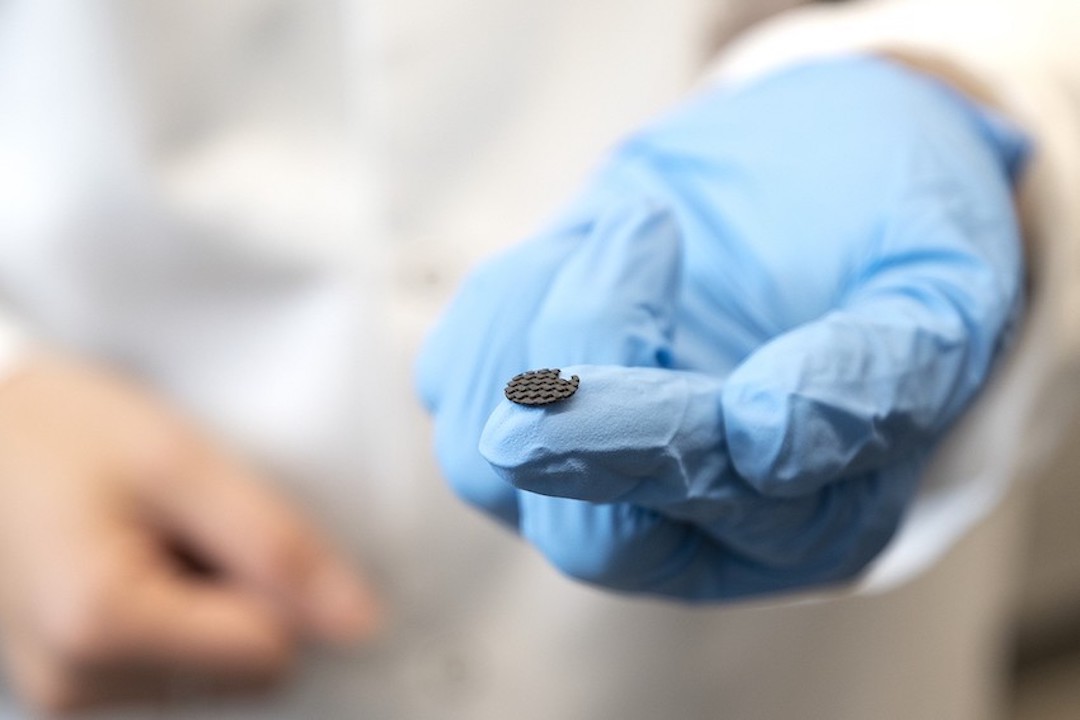
As NASA prepares to send humans back to the Moon for the first time in decades, scientists here on Earth have been working at creating new innovations that astronauts could use for longer-term missions in the future.
Previously, scientists at the University of Manchester developed ‘StarCrete’—a building material made from extra-terrestrial dust, potato starch, and a pinch of salt that’s said to be twice as strong as concrete.
Now, a team from the University of Texas at El Paso (UTEP) and Youngstown State University (YSU) have partnered up with NASA for a $2.5 million project that will allow those traveling to space to 3D-print batteries using local materials instead of having to haul them there.
The project will enable astronauts to manufacture rechargeable batteries out of lunar or Martian regolith—the top layer of materials covering the surface of the Moon and Mars—maximizing the sustainability of future space missions by reducing payload weight and volume.
According to UTEP, it’s crucial that future missions to the Moon and Mars are able to utilize resources found on the celestial bodies to create habitable infrastructure, including habitation modules, power generation, and energy storage facilities.
To achieve this, scientists are currently looking into two types of 3D-printing processes, dubbed material exhaustion (ME) and vat photopolymerization (VPP), that will allow astronauts to create shape-conformable batteries while in orbit.
Simply put, shape-conformable batteries involve complex 3D designs that outperform existing types of batteries, as they’re better suited for use in small spacecraft, portable power devices, robots, or large-scale power systems used in space.
“This project with NASA is an opportunity to demonstrate UTEP’s expertise in both energy storage and 3D printing,” Alexis Maurel, PhD, French Fulbright Scholar in the UTEP Department of Aerospace and Mechanical Engineering.
“Additive manufacturing appears as a unique approach to manufacture shape-conformable batteries to support human operations in space and on the surface of the Moon or Mars, where cargo resupply is not as readily available.”
[via Universe Today and SpaceRef, cover image via JR Hernandez / UTEP Marketing and Communications]


