
US Air Traffic Control Towers To Honor IM Pei’s Legacy With Fresh Eco Redesigns
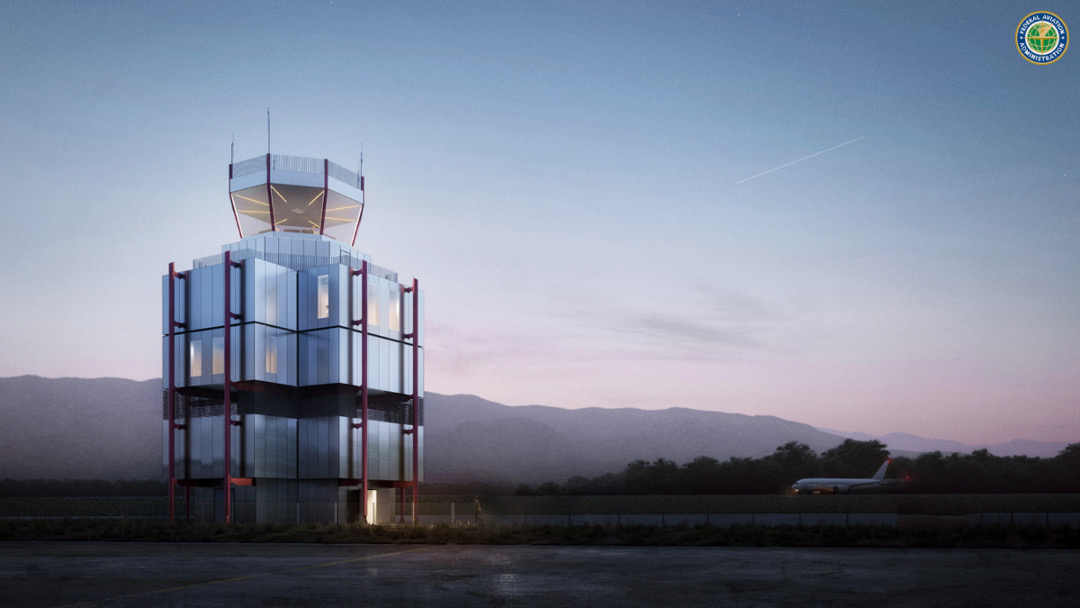
Image via PAU / Federal Aviation Administration
Look up and ahead. The Federal Aviation Administration (FAA) is soaring into the future with the grandest commission of air traffic control tower designs since the ones dreamed up by late Chinese-American architect IM Pei. Helming the project is New York-based Practice for Architecture and Urbanism (PAU), which won an open design competition by the authority to create modular airport towers that won’t just be cost-friendly but also address modern environmental challenges.
PAU’s overhaul will feature a cylindrical tower in the middle, with an eight-sided control room at the top. Surrounding the structure will be adaptable metal boxes that can be added by each territory to create specific spaces like storage and janitorial rooms, per Dezeen.
The crux of the studio’s redesign is that the buildings pay homage to “Pei’s magic, while acknowledging that the future is far less certain than the luminaries of yesteryear thought it to be.” The mid-century air traffic control tower envisioned by the famed architect in the 1960s—still in use by some airports—comprises a concrete structure that can also be customized, with an angular control deck crowning the tower.

The modern-day version will build upon Pei’s vision, but include things like all-electric building systems, a thermal-efficient façade, seasonal natural ventilation, renewable mass timber materials, recycled steel and metal products, ground-source heating and cooling, and fresh-air ventilation.
The control room will prioritize employee wellbeing, and will consist of elements like integrated daylighting and “comfort systems,” describes PAU.
The FAA has selected a new design for air traffic control towers. The sustainable concept was awarded to Practice for Architecture and Urbanism (PAU) and allows for electric/thermal efficiency and reduced construction costs. Learn more about the design at https://t.co/wyV2Z0topO. pic.twitter.com/bhXGjhAbF8
— The FAA âœˆï¸ (@FAANews) April 20, 2023
The concept will first inspire facilities at 31 airports in the US, many of which will be smaller regional and municipal airports. Over time, though, the FAA expects that the design will be brought to more than 100, potentially larger, airports.
The towers will stand anywhere between 63 and 119 feet tall. Like some of the alternative air traffic control structures for smaller airports designed by Pei, these versions will also have a metal skeleton-like frame to support their modular units.
The boxes can easily be assembled by maintenance crews to align with individual climates and seismic conditions, which would keep operational and construction costs low all while adapting to the local surroundings.
“These new airport traffic control towers will mean that smaller airports can handle more flights, more sustainably and more affordably,” expresses US Transportation Secretary Pete Buttigieg in a statement.
“I look forward to seeing this design go from the drawing board to construction sites across the country, helping our nation’s airports support more travelers, grow their local economies and prepare for the future of low-carbon aviation,” Buttigieg continues.
PAU founding principal Vishaan Chakrabarti says the studio is “thrilled” to have been challenged to navigate the “next-generation” design within tight constraints.
The FAA believes that the first of the new airport traffic control towers could break ground as soon as 2024.
[via Dezeen, Archinect, US Department of Transportation, images via PAU / Federal Aviation Administration]


