
NASA Spots Farthest Star Ever Detected—It’s 1,000,000x Brighter Than The Sun
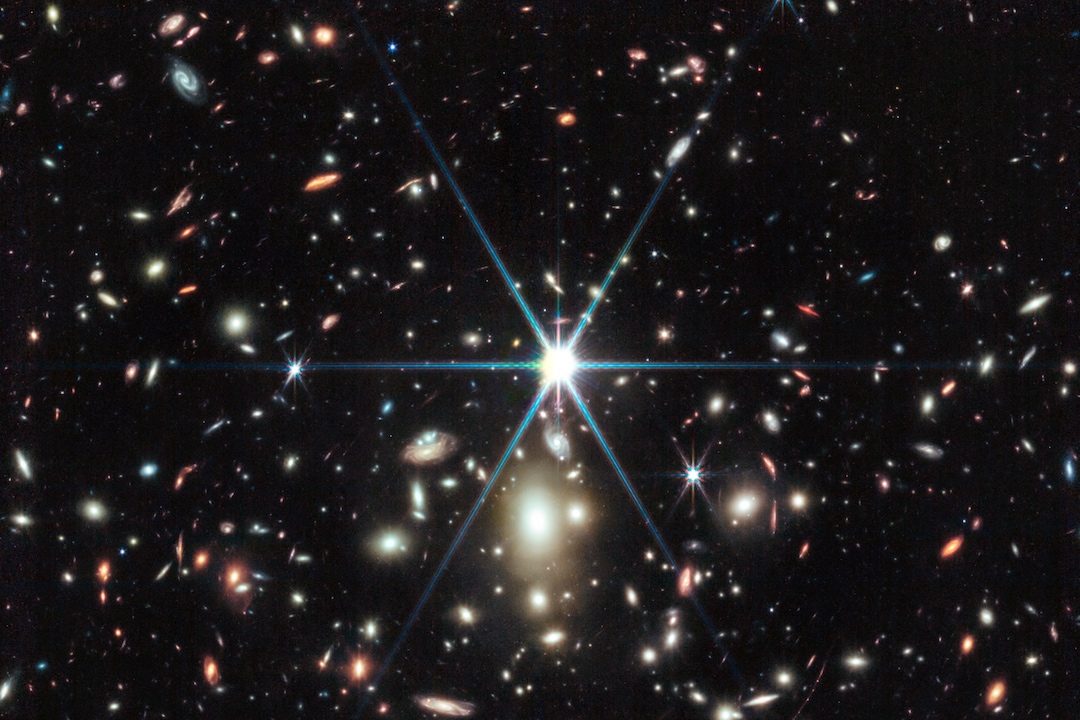
In a significant milestone, NASA’s James Webb Space Telescope (JWST) has captured an image of the most distant star ever detected in the early universe.
Building on the observations made by the Hubble Space Telescope, the JWST’s Near-Infrared Camera (NIRCam) managed a shot of the image of a massive B-type star, aptly named Earendel.
This distant celestial entity, which takes on the moniker of a mythological Anglo-Saxon figure dubbed “the Morning Star,” is located in the far-off Sunrise Arc galaxy.
Interestingly, the true marvel lies not only in the star’s impressive characteristics—being over twice as hot as our Sun and emitting a luminosity a million times more potent—but also in the fascinating mechanism that allowed its detection.
Earendel is only detectable thanks to a galaxy cluster between the star and us. The cluster’s gravity bends light, magnifying what's behind it—in the case of Earendel, by a factor of at least 4000! Based on its colors, astronomers think Earendel may have a cooler companion star. pic.twitter.com/gX2vgcLikd
— NASA Webb Telescope (@NASAWebb) August 9, 2023
Gravitational lensing, a phenomenon where the fabric of space is warped due to the immense mass of a celestial body, played a pivotal role in this discovery.
Both the Hubble and the JWST were able to observe Earendel due to its fortunate alignment behind the massive galaxy cluster WHL0137-08.
This alignment created a magnifying effect, akin to peering through a cosmic magnifying glass, allowing astronomers to study the distant star in unprecedented detail.
The telescope’s capabilities offered unique insights into Earendel. Unlike other objects in the galaxy that appeared multiple times due to gravitational lensing, the star appeared as a solitary point of light in the high-resolution infrared images captured by Webb’s NIRCam.
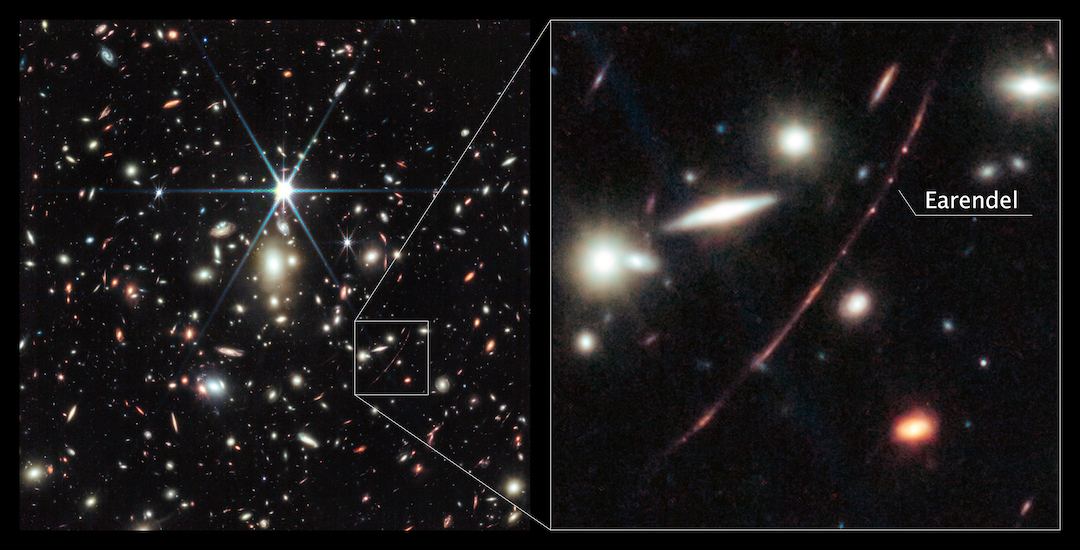
This anomaly indicated that the star was magnified by a factor of at least 4,000, underlining its minuscule size. Scientists posit that Earendel was formed just one billion years after the Big Bang, setting a new record for the most distant star ever spotted.
Previously, the record belonged to a ball of fire the Hubble had discovered, believed to have appeared in space four billion years after the beginning of the universe.
In addition, researchers were surprised when they spotted a potential companion star to Earendel surprised researchers.
While the closeness of the two stars might render them indistinguishable in the night sky, the advanced instruments managed to detect hints of a cooler, redder companion.
What about second breakfast? ðŸ§â™‚ï¸
— NASA (@NASA) August 9, 2023
We're eating up @NASAWebb's second look at the star Earendel, first seen by @NASAHubble. It's the farthest star ever detected, & Webb now shows it to be more than twice as hot as our Sun and about a million times brighter: https://t.co/FHPkuImzRc pic.twitter.com/9eN7CDcmKP
There’s no doubt the Sunrise Arc galaxy holds more treasures to explore, boasting an intricate balance between young star-forming regions and established star clusters.
This could offer astronomers insights into the universe’s earliest stages, revealing star-forming regions less than five million years old and older clusters exceeding 10 million years.
The observations also provide a window into the past, showing what the globular clusters in our Milky Way may have looked like 13 billion years ago.
Webb is also able to see other details in Earendel’s host galaxy, the Sunrise Arc—the most highly magnified galaxy yet detected in the universe’s first billion years. It features both young star-forming regions & older, established star clusters as small as 10 light-years across.
— NASA Webb Telescope (@NASAWebb) August 9, 2023
[via CNN and The National News, images via various sources]
This article was crafted with assistance from an AI engine, and has been manually reviewed & edited.


