
Researchers Reveal How Prehistoric Artists Would Have Lit Up Their Cave Studios
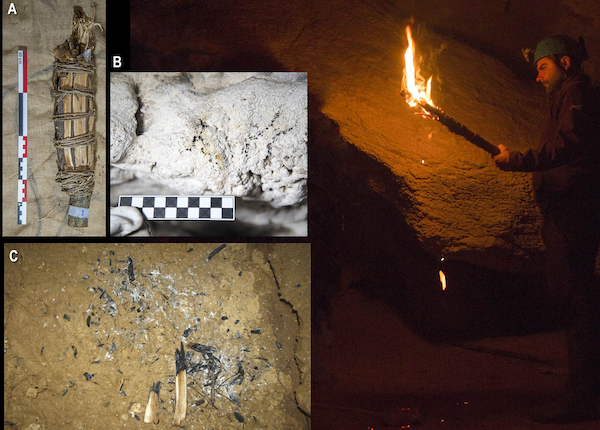
Image via Medina-Alcaide et al
Researchers and scientists have always sought to understand our prehistoric ancestors’ cave art, though no one really had details of how the works were made.
Now, a new study on ancient lighting techniques gives new insight to how ancient artists might have worked in their cave studios.
As part of the study, Spanish archaeologists Ángeles Medina-Alcaide, Diego Garate, Iñaki Intxaurbe, José L. Sanchidrián, Olivia Rivero, Catherine Ferrier, Dolores Mesa, Jaime Pereña, and Iñaki Líbano performed experiments to uncover how prehistoric artists constructed a steady light source in their caves.
Based on evidence found in Paleolithic sites in Southwest Europe, scientists understand these cavemen used three main light sources: torches, fireplaces, and portable grease lamps.
By performing experiments using all three sources, the researchers learned about the peculiarities of each choice, including the types of residue each technique produced.
According to ARTnews, the study found that fireplaces restricted the cave’s already-limited airflow, while torches were useful for exploration but not sustained work.
Torch flames were often unpredictable, and could sometimes create more smoke than light, hindering the cavemen’s artistic processes. Grease lamps turned out to be the steadiest form of light, though they had to be positioned correctly as the scope of light was somewhat limited.
Despite the study’s comprehensive findings, there’s still one question scientists have yet to shed light on—why the cavemen artists chose to work deep inside the caves, rather than at the entrances.
“They could have made drawings just at the entrance of the cave without any problem. They wanted to do it in these narrow places and go very deep inside the caves,” scientist Diego Garate told CNN.
While we’ll never resolve all the mysteries surrounding our prehistoric ancestors and their art, this study brings us a little closer to what they might have experienced back then.
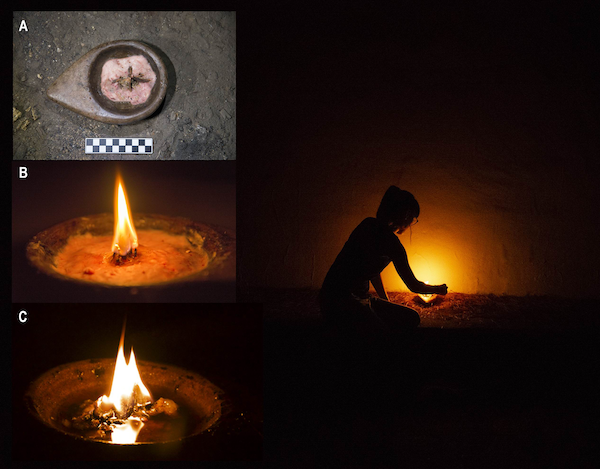
Image via Medina-Alcaide et al
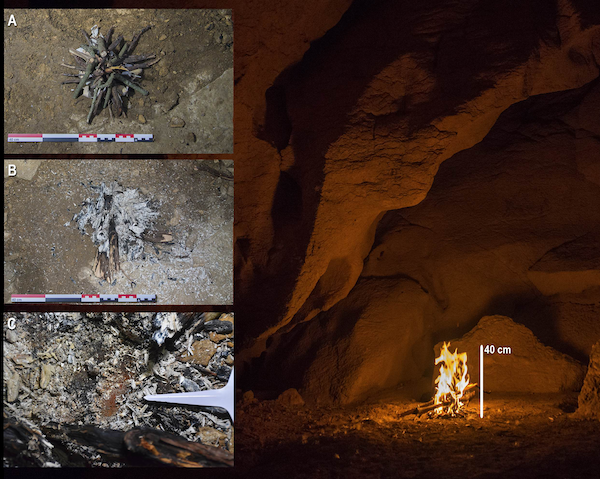
Image via Medina-Alcaide et al
[via ARTnews, images via Medina-Alcaide et al]
Also check out these recent news


