
NASA Rover Said To Inspect Mars’ Lakes Might’ve Been Mistaken For Almost 8 Years
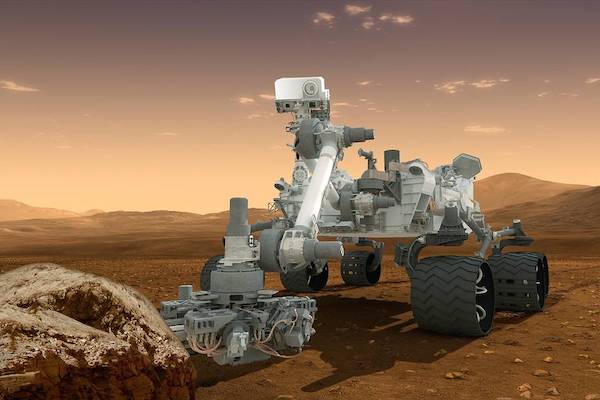
Image via NASA
When the Curiosity rover was landed in Mars’ Gale crater by NASA in 2017, it had set off to explore what scientists believed was a lake on Mars more than 3 billion years ago.
Geological analyses were carried out and tools were used to capture information about the lake. It drove merrily along for more than 3,190 sols (Martian days), which is about 3278 Earth days. Then researchers arrived at the possibility that the sediments they had been studying didn’t actually come from a lake.
Instead, the team from the Department of Earth Sciences at the The University of Hong Kong have proposed that the pile of rocks the Curiosity has been diligently investigating all this time is actually made of sand and silt that had landed from air-fall—not elements that were formed as a result of a wet, aqueous environment.
In the study published in Science Advances, the team also describes how “the rocks that are decidedly lacustrine [associated with lakes] in origin represent only a small fraction of the geologic record so far explored.”
A damp environment was thought to have been the catalyst for alteration minerals. However, the team has also suggested that this was a result of weathering under rainfall in a vastly different atmosphere all those millions of years ago.
Kitted out with a suite of 10 of the most advanced science instruments and 17 cameras, the Curiosity has returned more than 700 images of the once-mystical planet so far. It has also proved that “long-range mobility” is possible on Mars, alongside the ability to explore “diverse environments”.
[via SciTechDaily, image via NASA]
Also check out these recent news


