
NASA Reveals What Mars’ Interior Looks Like For The First Time Ever
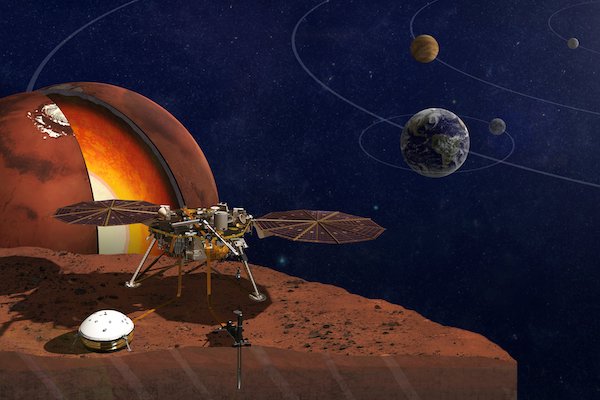
Image via NASA
The surface of Mars has been of somewhat known territory since 1976, when NASA’s Viking 1 lander took the first ever image of it. But now, almost 50 years after, Viking 1’s descendant InSight has found information about the planet’s interior for the first time.
In the context of Mars, seismic waves cause “marsquakes,” which have allowed scientists to study the planet’s inner structure since 2019. The waves’ speed and shapes depend on the materials which they travel through. InSight’s seismometer, the Seismic Experiment for Interior Structure (SEIS), utilized these to come to its findings.
Three papers were published by a team of researchers in the Science journal, detailing the planet’s depth and composition. With a paper dedicated to each of the following areas, facts about its mantle, crust, and core were revealed, including a confirmation that the center of the planet is, indeed, molten.
Other findings include that Mars’ crust is thinner than previously believed, and might be made up of sub-layers. It goes 12 miles deep if there are two sub-layers, and 23 miles if there are three. Following that is the 969-mile-deep mantle before reaching the molten core, which spans a radius of 1,137 miles.
“This study is a once-in-a-lifetime chance,” said Simon Stähler, lead author of the ‘core’ paper. “It took scientists hundreds of years to measure Earth’s core; after the Apollo missions, it took them 40 years to measure the Moon’s core. InSight took just two years to measure Mars’ core.”
But the SEIS and the team’s work doesn’t end here. New marsquakes are detected by SEIS pretty much daily, and the team is waiting for one that exceeds 4.0.
“We’d still love to see the big one,” JPL’s Mark Panning, co-lead author of the ‘crust’ paper, explains. “We have to do lots of careful processing to pull the things we want from this data. Having a bigger event would make all of this easier.”
Opening the lid on trash-bin foraging behaviors in suburban parrots, a case for intranasal #COVID19 vaccinations, and revealing the interior of Mars.
— Science Magazine (@ScienceMagazine) July 22, 2021
📕 Read the latest in Science: https://t.co/VP1LjsXCOR pic.twitter.com/FXSHoir14t
I’ve mapped the interior of Mars for the first time and found some surprises:
— NASA InSight (@NASAInSight) July 22, 2021
- Crust: thinner than expected, with maybe two or three sub-layers
- Mantle: a single layer (969 mi/1,560 km), simpler than Earth’s
- Core: larger than expected (1,137 mi/1,830 km radius), and molten pic.twitter.com/cLgQVkwBnz
For the first time, seismologists have imaged the interior of another planet, besides Earth! Three studies just published in @ScienceMagazine present results for the crust, mantle and core of Mars, summarised in this Perspective by @DeepEarthExplor and me: https://t.co/3Am8Cd9hGQ pic.twitter.com/wyMowYFGYy
— Paula Koelemeijer (@seismo_koel) July 22, 2021
[via CNET, cover image via NASA]


