
This Hypersonic Jet Can Take You From New York To London In Just An Hour
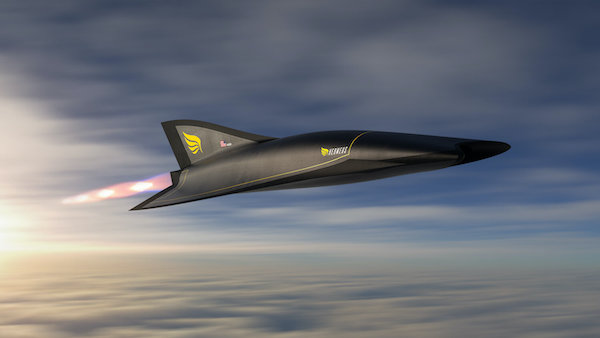
Image via Hermeus
Although supersonic jets such as those of NASA and United Airlines, have yet to go commercial, it seems they’re already passé. Now, there’s a hypersonic jet in the works that’ll fly you from New York to London in just an hour.
The hypersonic jet, called the Hermeus Quarterhouse, flies at five times the speed of sound (also named Mach 1). Last week, Atlanta-based aviation startup Hermeus—named after the Greek god Hermes—announced it had received US$60 million in funding from the US Air Force to test the aircraft, while NASA was involved in designing the jet.
The jet is designed to travel at a top speed of Mach 5.5, or 4,219 mph, and can ferry passengers across the cities in under 60 minutes, making it the fastest reusable aircraft on Earth.
According to Robb Report, the hypersonic jet’s speed will come from its turbine-based combined cycle (TBCC) propulsion system. A standard jet engine will be used for liftoff and landing, with the aircraft going into second turbine once it reaches the correct altitude and airflow.
Impressively, in just nine months, Hermeus has managed to bring the project from concept to creation and testing. Plus, the aircraft will be tested autonomously, so prototypes will be able to be tested in the air without risking the lives of pilots.
Currently, the firm plans to test a small-scale version of the aircraft in 2023, with a mid-size cargo-carrying version coming two years later, and a large commercial model expected to arrive in 2029.
Of course, with the grant coming from the US Air Force, Hermeus will also be working on military uses for the hypersonic aircraft.
AJ Piplica, the company CEO, said: “While this partnership with the US Air Force underscores US Department of Defense interest in hypersonic aircraft, when paired with Hermeus’ partnership with NASA announced in February 2021, it is clear that there are both commercial and defense applications for what we’re building.”
Though we’re still one or two decades away from achieving commercial hypersonic travel, the thought of only taking an hour to cross the ocean sounds like the futuristic dream we all expected at the turn of the millennium.
[via Robb Report, cover image via Hermeus]
Also check out these recent news


