
Hubble Captures ‘Flaming Sword,’ The Result Of A Rare Celestial Occurrence
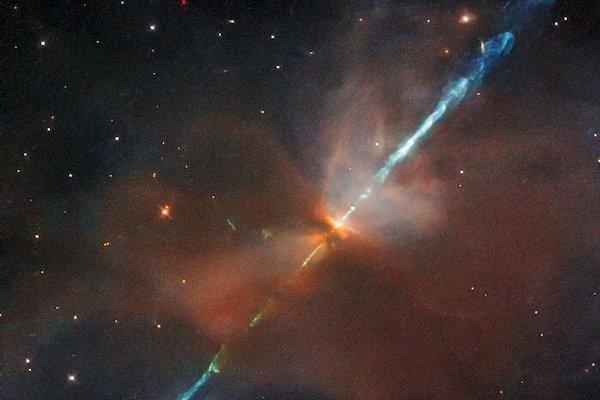
Image via ESA/Hubble & NASA, B. Nisini
A breathtaking new photo was captured by the Hubble Space Telescope, depicting what looks like a flaming sword piercing through a heart.
Known as a Herbig-Haro object, this rare sight is the result of the interaction between jets of ionized gas and leftover dust and clouds. “Very specific circumstances” are needed to form this object, writes the European Space Agency (ESA) in the image description.
Newly formed stars are first required to “expel very narrow jets of rapidly moving ionized gas” that have been highly charged due to heat-induced loss of electrons. Then, this stream of gas has to collide with the clouds of dust and other gases that surround aforementioned newly-formed stars.
This Herbig-Haro object in particular is named HH111. Located about 1,300 light-years from Earth, it lies peacefully in the Orion constellation. The jets of gas in this object are projected into space from opposite poles of a newborn star, named IRAS 05491+0247.
These objects “actually release a lot of light at optical wavelengths,” states the ESA. However, they're often “difficult to observe because their surrounding dust and gas absorb much of the visible light.”
Enter Hubble’s Wide Field Camera 3 (WFC3). This instrument is used for observing both optical and infrared wavelengths of light.
In this scenario, infrared wavelengths are especially useful because they’re not affected by gas and dust in the same way as optical wavelengths are.
Hubble has been through a lot lately, including a technical error that caused it to shut down earlier this year. But after being saved by the scientists who know and love it well, it’s now back and functioning again. Here’s to the telescope continuing to provide us a glimpse into the mystical universe around our contextually tiny Earth.
[via Space.com, image via ESA/Hubble & NASA, B. Nisini]
Also check out these recent news


