
NASA’s Perseverance Captures Rock Samples With Water, Suggesting Life On Mars
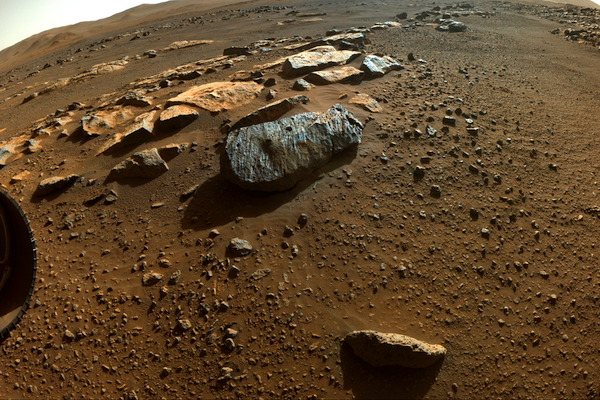
Image via NASA / JPL Caltech
One of the—if not the most important—objectives of NASA’s Perseverance mission on Mars is astrobiology, to investigate signs of microbial life. This helps to develop the potential for human-led expeditions or future inhabitance.
Alongside the discovery that naturally formed caves may provide shelter from otherwise dangerous amounts of radiation, another promising find is a pair of rock samples that suggest water.
It has been known that the Jezero crater, the area the rover is exploring, used to be an ancient lake. However, it’s been hard to find out how long the lake existed for, and if it was there for millions of years or just the result of a flash flood.
But now, the rocks reveal that the water was indeed present for a long period of time.
Of the two, the first sample named Montdenier was picked up on September 6 by the Perseverance rover. The second, Montagnac, was collected from the same rock on September 8. Both are currently safely stored inside the rover.
Two for two: I have successfully processed and stored my second sample of Mars, thus bringing my total to two Martian rock cores in one week.
— NASA's Perseverance Mars Rover (@NASAPersevere) September 8, 2021
More images: https://t.co/L6lhCNdqWq
Tune in to watch my team share more this Friday: https://t.co/Q24DiF42q0 pic.twitter.com/57AhLdldcR
Analysis of the rocks revealed that they were basaltic in nature, possibly having come from lava flows. Within them, salts were detected, and this isn’t part of the natural rock.
It was suggested that the salts may have been formed when groundwater flowed through the rock, and “altered the original minerals” in it. Another possible explanation is that when liquid water evaporated, the salts were left behind.
Both suggest the presence of water, which in turn suggests the presence—and possibility—of life.
“It looks like our first rocks reveal a potentially habitable sustained environment,” said Ken Farley of Caltech, and project scientist for the Mars mission. “It’s a big deal that the water was there a long time.”
The team wrote in the press release that ancient Martian water may have also been preserved in the rocks, trapped as tiny bubbles. If so, these would “serve as microscopic time capsules” to provide information about the ancient climate and habitability of the planet.
Additionally, crystalline minerals present in the rocks enable scientists to date the rocks more accurately and learn more about the crater’s history, as well as the geological history of the mysterious red planet. Salt is great for preservation here on Earth, and it’s the same on Mars.
According to Mitch Schulte, the mission’s program scientist, the rock samples “have high value for future laboratory analysis back on Earth” and will one day “help answer the big-picture science question of the history and stability of liquid water on Mars.”
After Perseverance’s first sampling attempt turned out to be somewhat of a flop, it’s safe to say that the rover has redeemed itself through this effort.
My first two rock samples are likely volcanic with hints of salts that may hold bubbles of ancient water. They’re pieces of a bigger puzzle, to learn:
— NASA's Perseverance Mars Rover (@NASAPersevere) September 10, 2021
- how this area formed
- its history of water
- if past life ever existed here
More on #SamplingMars: https://t.co/rFOBz2Mrak pic.twitter.com/ztugkQwFQi
[via ScienceAlert, image via NASA / JPL Caltech]
Also check out these recent news


