
LG Co-Designs Battery Made Entirely Of Silicon That Lasts Longer Than Usual Ones

Image via University of California San Diego
Researchers from UC San Diego, in collaboration with LG Energy Solution, have managed to surprise even themselves with their latest discovery: a solid-state battery with an anode made entirely of silicon.
This may be the key to creating something with longer life and higher energy density than the conventional battery.
Silicon anodes have a good reputation for high energy density in comparison with regular graphite anodes, but they’re also known for expanding and contracting according to the battery’s charge and discharge.

Image via University of California San Diego
Another disadvantage is that they degrade with liquid electrolytes, which is what conventional lithium-ion cells use today. So, to combat this, just make them solid, right?
But this doesn’t come without its own problems; solid-state batteries require metallic lithium anodes. These have to be kept at high temperatures during charging, which renders them impractical in cold weather.
Enter the anode, which hits both birds with a singular (silicon) stone. When made of this material, the battery allows for a fast charge rate at room temperature while retaining the high energy density we all crave.
Additionally, carbon and binders were removed from this anode. This allowed the team to “avoid” the challenges that came with soaking the anode in organic liquid electrolyte as the battery carries out its performance.
The removal of carbon also ensured that the battery itself has a longer lifespan: when contact with the solid electrolyte is reduced, the “continuous capacity loss” that plagues our batteries today is also reduced.
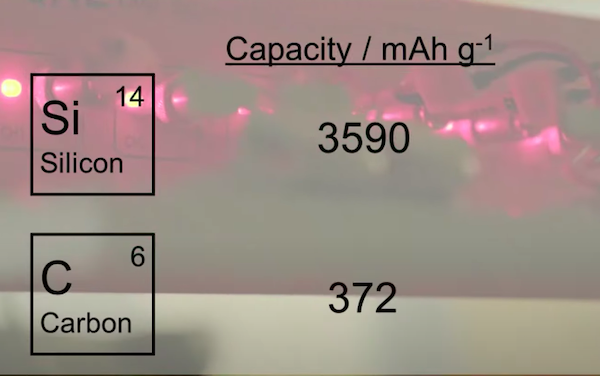
Image via University of California San Diego
To demonstrate this new technology, the team experimented on a lab-scale cell. As reported in the press release, the researchers found that it could deliver 500 charge and discharge cycles at room temperature, with 80% capacity retention.
”With this battery configuration, we are opening a new territory for solid-state batteries using alloy anodes such as silicon,” states Darren H. S. Tan, the lead author of the paper published in the Science journal last week.
With the rise of electric vehicles and other similar technologies, batteries and their technologies look to be in higher demand than ever. New systems, like this or a sweat-powered battery, could change the way we power things forever.
There may, however, also be the option to just do entirely without them.
[via Engadget, image via University of California San Diego]
Also check out these recent news


