
This ‘Chef’ 3D-Prints Chicken & Cooks It With Laser-Sharp Precision, Literally
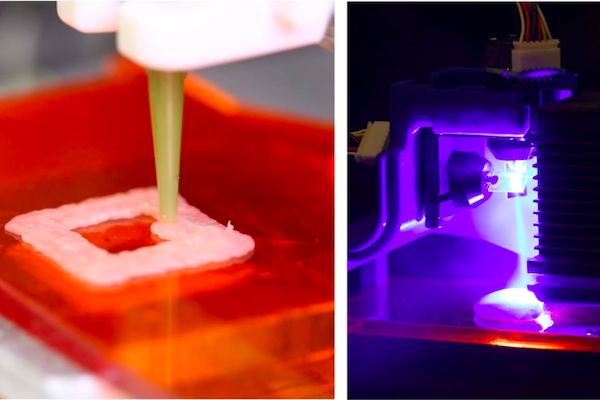
Image via Columbia University
Forget 3D-printed infrastructure like homes and bridges, or a 3D-printed version of Michelangelo’s David. 3D-printed chicken has just hit the scene.
Not only that; the chicken breast cutlets are 3D-printed and cooked via lasers at the same time for a sizzling hot delivery. How’s that for live cooking?
You have naught but the team of scientists of Columbia University, New York, to thank for this. The “chef” comes in the form of a machine that is equipped with the ability to 3D-print the meat before carrying out “precision cooking” through “multiwavelength lasers.”
Okay, so the chicken doesn’t materialize out of nowhere like the visual of “3D printing” might induce. This research doesn’t cover any attempt to create realistic meat like wagyu beef from materials that are anything but.
In this scenario, the team had fed the machine a blend of puree chicken, which it then turned into the cuts that were cooked. That, in itself, is still pretty cool, though. There’s also no saying that chicken materializing out of nowhere is totally impossible for the future, so maybe we’ll see that next—who knows.
In a paper published in the journal npj Science of Food this month, the team states that the main challenge to overcome was “the spatially controlled delivery of cooking energy.” This is where the lasers come in.
They allow for a precise, easily controllable jet of heat energy to be directed straight to where the chicken needs it. It can even cut through packaging to cook it in its own packet.
Experimenting with a few different types of lasers, the team found that infrared lasers brown the food “more efficiently” than blue ones, but blue lasers were better at cooking the meat internally, apparently.
It’s believed that this “chef” technology will “enable more creative food design” by allowing its users to customize their meals and cooking to a higher degree, especially those who cannot stand the thought of toiling away at a kitchen only to yield something barely edible.
According to Ars Technica, the reconstructed bit of chicken was reported to have retained more moisture and shrank less during cooking than chicken cooked regularly.
In what may be one of the world’s smallest taste trials ever, the duo who participated decided the 3D-printed, laser-cooked chicken was better than the conventionally prepared one. This was even despite the fact that they could taste the metallic “charred” taste the laser left behind during cooking.
Apparently, it’s a bit like the smell you get when you have your fillings sealed at the dentist. “A little bit of an industry odor,” the researchers told Ars Technica. “A sharpness that you don’t get with normal chicken.”
The crème de la crème of the 3D-printed food industry, perhaps.
[via Futurism, image via Columbia University]
Also check out these recent news


