
Scientists Develop First 3D-Printed Wagyu Beef For Top-Class Meat Sans Slaughter
Image via ID 191043306 © Nopadol Uengbunchoo | Dreamstime.com
Scientists at Osaka University have made an incredible breakthrough in the world of meat alternatives. The researchers were able to use stem cells isolated from cows that produce Wagyu beef to 3D-print a virtually identical substitute.
The 3D-printed beef contained muscle, fat, and blood vessels arranged in a way that closely resembled conventional Wagyu steaks.
Japan’s Wagyu steaks are widely considered as some of the best beef on the market, with its high content of sashi (marbling) that gives the beef a richer flavor than other cuts. Although the move towards meat-free alternatives has yielded a wide array of new products in the last several years, no one has been able to replicate the complex structure of Wagyu beef just yet. Till now.
Recently, the Osaka University scientists have cracked the code — using 3D-printing to create a meat alternative similar to the real thing.
“Using the histological structure of Wagyu beef as a blueprint, we have developed a 3D-printing method that can produce tailor-made complex structures, like muscle fibers, fat, and blood vessels,” said the study’s lead author Dong-Hee Kang.
According to The Brighter Side Of News, the team first began with two different stem cells. Under the right conditions, these “multipotent” cells are able to differentiate into every type of cell needed to replicate meat. Individual fibers such as muscle, fat, and blood vessels were then produced from these cells using a method termed bio-printing.
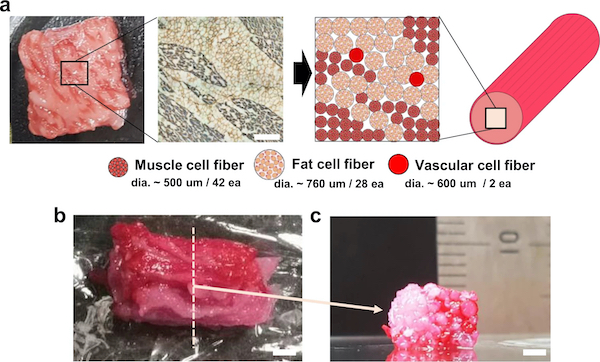
Image via Osaka University
Following which, the printed fibers were arranged into a 3D model, following the histological structure of real Wagyu meat to reproduce its texture. Not only does the process create a beef alternative, but it also enables complex meat tissue structures to be customized.
“By improving this technology, it will be possible to not only reproduce complex meat structures, such as the beautiful sashi (marbling) or Wagyu beef, but to also make subtle adjustments to the fat and muscle components,” explained senior author Michiya Matsusaki.
This could mean that in the future, customers could order meat alternatives with customized amounts of fat and muscle, based on individual preferences. Could personalized meat be where the alternative meat industry is headed? Maybe cheeseburgers could finally be turned into something healthy, after all.
For more information, check out the study here.
[via The Brighter Side Of News, images via various sources]
Also check out these recent news


