
Meet ‘Electra’, A ‘Flying’ Zero-Emission Ferry That Can Be Recharged In 3 Hours
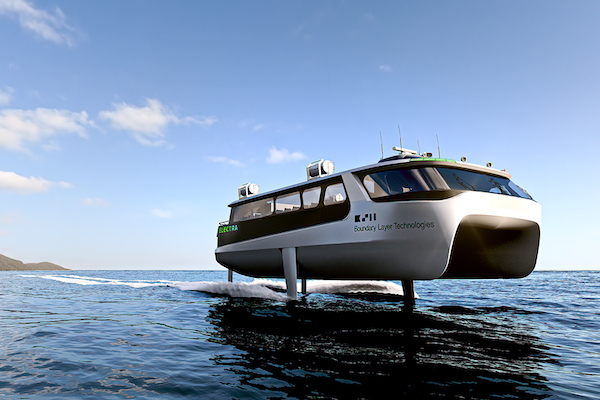
Image via Boundary Layer Technologies
Flying cars and hoverboards may have been associated with visions of a futuristic society for decades, but a flying ferry never quite made it there. Nevertheless, that might be coming our way too.
Boundary Layer Technologies, a startup specializing in zero-emissions cargo ships, has just revealed the ‘Electra’, a hydrofoil electric ferry that can quite literally soar over the seven seas. It’s been fittingly named after Electra, the Greek Goddess of the Sea Clouds.
Thanks to the company’s proprietary hydrofoil technology and podded propulsion system, Electra gets to enjoy a reduced drag by a factor of two. The foils allow the ferry to hover above water as it travels, having it “fly” to its destination.
This also halves the powering requirements, which means that it has capabilities of twice the speed and range of existing electric ferries. It reportedly clocks in at 40 knots and 100 nautical miles respectively on a single charge, according to Ed Kearney, CEO of Boundary Layer Technologies.

Image via Boundary Layer Technologies
100 nautical miles are, as the company describes, enough to cover more than 90% of commuter ferry routes in the United States, or 48% of the ferry routes in the Greek region.
Robb Report details that the ferry will have a 9,000-kWh battery pack installed below the deck, and this can be fully recharged in just three hours. Additionally, thanks to it being battery-powered, cabin noise for the 150 passengers it can carry would be “significantly” reduced by up to 20 decibels as compared to conventional fossil fuel vessels.
“Hydrofoil technology is the key to enabling electrification of passenger ferries,” Kearney says in the company’s statement. He also describes Electra as a creation that “opens the door to electrification of the majority of ferry routes across the world.”
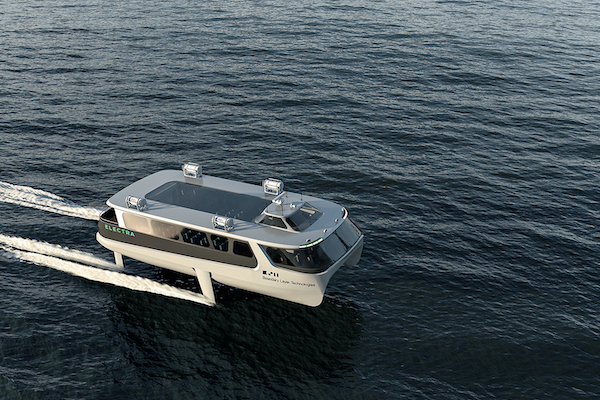
Image via Boundary Layer Technologies
Of course, Electra emits no fumes in its operations and would greatly help in reducing the industry’s carbon footprint. Outside of this ferry, Boundary Layer Technologies has stated that its wider vision is to reduce global GHG emissions by at least one percent.
Although the design is still referred to as a concept for now, the first Electra vessels are planned to begin operation by early 2024 in the United States, Scandinavia, and the Mediterranean.
[via Robb Report, all images via Boundary Layer Technologies]
Also check out these recent news


