
Mechanical Trees Lift Nature’s Burden By Efficiently Sucking CO2 From The Air
Carbon capture, the act of removing heat-trapping carbon dioxide (CO2) from the planet’s atmosphere, has been a technology gradually on the rise.
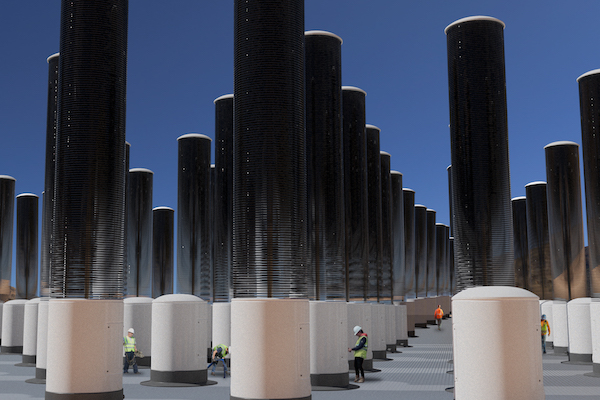
One proposed way of doing this is via a mechanical tree, as Klaus Lackner, a professor from Arizona State University, explains. This device, designed by Lackner, is capable of extracting CO2 from the air to lessen the burden of climate change.
In an interview with Inverse, Lackner describes the trees as tall “columns of discs coated with a chemical resin, about five feet in diameter, with the discs about two inches apart, like a stack of records.”
The material coating the discs, Lackner explains, is one that absorbs CO2 when dry and releases it when wet. He claims that this requires a lot less energy than other systems, which also means it costs less.
When air blows through it, the discs’ dry surfaces absorb CO2. Around 20 minutes later, when the discs are full, they “sink” into a barrel. Water and steam are used to “release” the captured carbon into a “closed environment.”
Okay, so, now what? “The world can actually put CO2 away permanently by taking advantage of the fact that it’s an acid and certain rocks are base,” Lackner states. When it reacts with calcium-rich minerals, for example, it’ll form solid carbonates. Of course, these are much easier to store than gas.
Or, the captured air can be used in a sort of closed-loop system where it’s used, captured, then reused, and over again. Or it can be turned into something else.
The US Department of Energy has a new goal with regards to direct air capture, with the aim of removing “gigatons” of carbon pollution from the air by 2050 and finding a solution to storing it long-term for less than US$100 per ton.
Devices like Lackner’s trees, which is one of six projects being funded by the Department’s program, might just make it happen—hopefully long before the deadline.
[via Futurism and Inverse, image via Arizona State University]


