
Lotus Plant Inspires This Self-Cleaning Bioplastic That Breaks Down In Compost
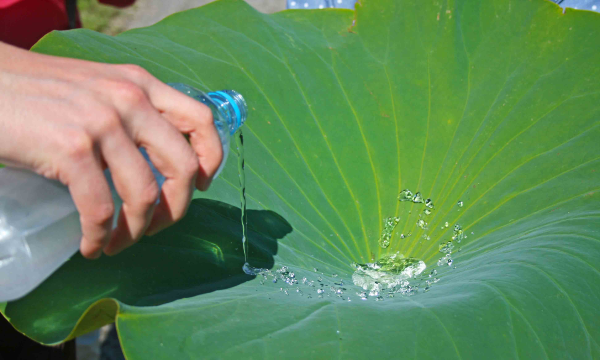
Scientists have developed a brand-new bioplastic that’s both compostable and self-cleaning, inspired by the naturally-occurring properties of the lotus leaf.
The new material not only repels liquid and dirt but also quickly breaks down when buried in soil or compost, as per studies published by the RMIT University team in the Science of the Total Environment and Applied Materials and Interfaces journals.
In the future, this bioplastic could be used to create packaging for fresh produce and food takeouts, thereby reducing the amount of plastic needed to store edible products.
“Plastic waste is one of our biggest environmental challenges but the alternatives we develop need to be both eco-friendly and cost-effective, to have a chance of widespread use,” explained Mehran Ghasemlou, lead author of the studies.
“We designed this new bioplastic with large-scale fabrication in mind, ensuring it was simple to make and could easily be integrated with industrial manufacturing process,” he added.
Science Daily reported that the material’s manufacturing process does not require any sources of heat or expensive mechanical equipment, allowing it to be quickly upscaled on a production line at minimum cost.

Image via RMIT University
According to Cosmos Magazine, the team based its design on the water-repellent structure of the lotus leaf to come up with a material that’s strong yet degrades easily.
The plant’s amazing leaf boasts an amazing water-repellent ability due to the waxy layer atop the tiny pillars that make up its surface. Any liquid that lands on the leaf doesn’t attach to it; rather, it remains a droplet and rolls off with gravity or the wind.
To ensure the bioplastic’s compostability, the team carefully sourced for ingredients that could be rapidly broken down by bacteria and bugs found in soil. This means synthetically engineering a material made from starch and cellulosic nanoparticles, before imprinting its surface with a pattern similar to that of the lotus leaf and coating it with a silicon-based organic polymer layer.
“There are big differences between plant-based materials—just because something is made from green ingredients doesn’t mean it will easily degrade,” noted Ghasemlou.
“Our ultimate aim is to deliver packaging that could be added to your backyard compost or thrown into a green bin alongside other organic waste, so that food waste can be composted together with the container it came in, to help prevent food contamination of recycling,” he said.
[via Science Daily and Cosmos Magazine, images via RMIT University]


