
Microscopic Robots Get ‘Brains’ That Let Them Walk With No ‘Strings’ Attached
Tiny robots may not be anything new. Yet, the drawback remains: there were always ‘strings’ attached.
Minuscule proportions are limiting them from adopting similar autonomous technologies that other larger bots are capable of housing.
“Before, we literally had to manipulate these ‘strings’ in order to get any kind of response from the robot,” said Itai Cohen, professor of physics in the College of Arts and Sciences at Cornell University.
Now, his team at Cornell University may have stumbled onto a discovery that essentially gives these tiny droids a basic ‘brain’.
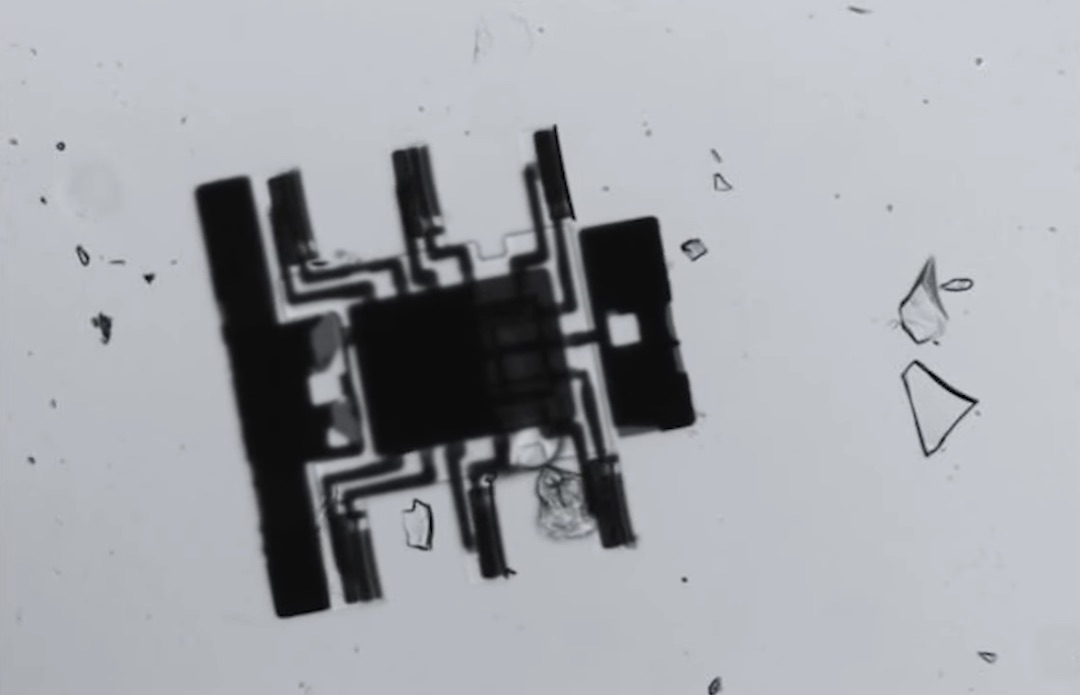
The microbots span no more than 250 micrometers—or, as pointed out by Interesting Engineering, smaller than an ants head—that have two, four, and six-legged versions. The two and six-legged models move around like insects, while the four-legged type is likened to a ‘dogbot’.
Each of these types has a microprocessor onboard its circuit that acts as its ‘brain’, allowing it to walk without being externally controlled.
Comprising of three systems, the first controls the legs; the second is a photovoltaic cell that can capture light to turn into energy; the last is a set of hinged legs that can create a movement greater than 10 micrometers a second.
The ‘brain’ can respond independently thanks to a complementary metal-oxide-semiconductors (CMOS) clock circuit. Within it resides thousands of diodes, capacitors, and transistors.
Energy churned by photovoltaics spurs its legs and circuit to start working by using phase-shifted square frequency wave signals to convert what the cells have captured into power.
Don’t expect the little bots to do any fancy tricks (yet). Its basic brain can only engage it to perform simple functions. At the moment, they do no more than walking.
However, scientists believe this is a step toward a new revolution of microbots that could do much service in the medical sector.
“It’s like taking the strings off the marionette. It’s like when Pinocchio gains consciousness,” Cohen described.
[via Engadget and Interesting Engineering, cover image via Cornell University]


