
Ancient Mayan Game Scoreboard Has Been Dug Up At Mexican World Heritage Site
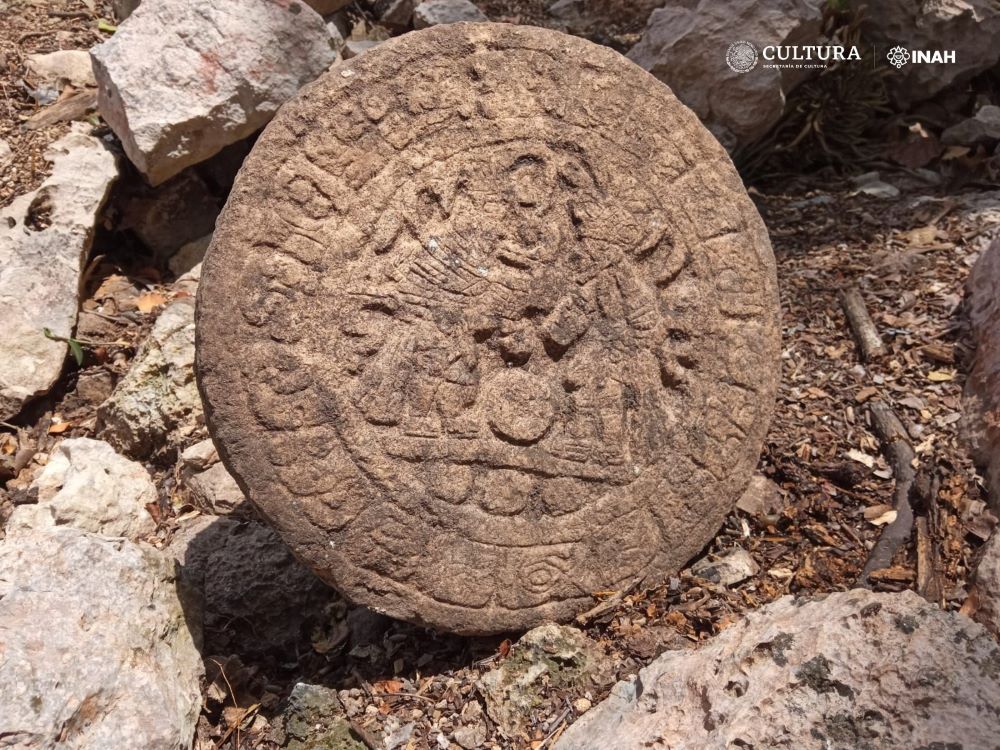
The Women’s World Cup is fast approaching. Almost in tandem with current events, a stone scoreboard for a Mayan ball game has been uncovered at the Chichén Itzá archaeological site, a UNESCO World Heritage Site on the Yucatán peninsula in Mexico.
The disc, measuring 12.6 inches in diameter and weighing 88 pounds, portrays two individuals in Mayan sporting attire, with hieroglyphic writing surrounding them. The artifact was exhumed by archaeologist Lizbeth Beatriz Mendicuti Pérez in the Casa Colorada complex, named for the traces of red paint found in the area, while she was at work for the Ministry of Culture’s Improvement of Archaeological Zones (Promeza) program.
It is believed that the slab hails from the Terminal Classic or Early Postclassic period, dating back to the 800s to early 900s AD.
This sort of discovery, with full hieroglyphic text, is uncommon—and the researchers are keeping score.
“In this Mayan site, it is rare to find hieroglyphic writing, let alone a complete text. It hasn’t happened for more than 11 years," notes fellow archaeologist Francisco Pérez Ruiz in a news release.
Looking closely, Santiago Alberto Sobrino Fernández, who led the iconographic and epigraphic study of the stone scoreboard, identified the player on the left to be donning a feathered headdress and sash with “a flower-shaped element, probably a water lily.” A scroll can be seen near the character’s face, potentially indicating a “breath or voice.”
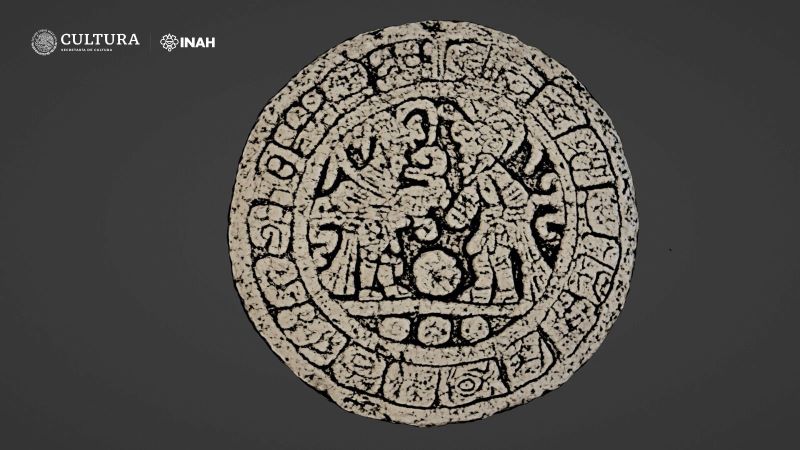
The opponent on the right is perceived to be wearing a “snake turban,” a look consistent with other depictions excavated in Chichén Itzá, along with ball court protectors.
The date on the disc, listed as 12 Eb 10 Cumku, times its supposed usage to AD 894.
According to Reuters, the game involved a heavy rubber ball and is said to have had ritualistic significance among the Mesoamerican people.
As the 1,000-year-old scoreboard was found in an inverted position and 23 inches from the surface, experts deduce that it was part of the east wall of the arch that led to the Casa Colorada architectural complex, and that it had fallen from there.

Researchers have now initiated photogrammetry scans to capture the disc’s glyphic writing and iconography in high resolution for future study.
[via The Guardian / Reuters and ARTnews, images via National Institute of Anthropology and History (INAH)]


