
Physicist Discovers Way To Create Cheap N95 Masks With A Cotton Candy Machine
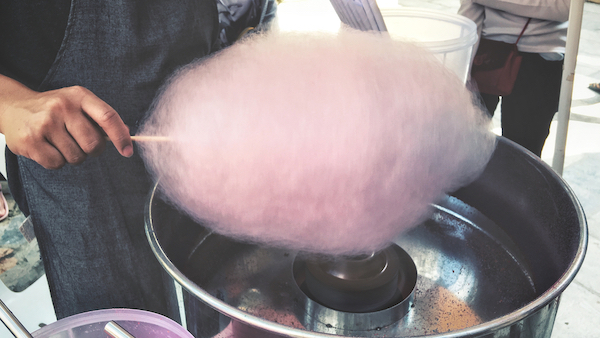
Image via Shutterstock
It was troubling seeing medical heroes fight the mysterious coronavirus despite a shortage of personal protective equipment. Over time, though, brands and manufacturers have stepped up to make face coverings accessible for everyone.
The N95 mask stands as the most effective contender, but that means it can also be expensive. One physics student seems to have found the sweet spot to making cheaper N95 masks, and it involves a cotton candy machine.
In a new paper, Mahesh Bandi, a graduate student in physics at the Okinawa Institute of Science, details that by using a common cotton candy machine, you can spin inexpensive run-of-the-mill plastic—the kind from water bottles and plastic bags—into electrocharged mesh, much like the type used in N95 coverings.
It’s worth noting that electrocharged plastic foam filters are among the pricier parts of an N95 mask. As explained by Good News Network, electrically-charged mesh blocks 95-percent of virus particles from entering the lungs, and is therefore essential to the makeup of the mask.
Bandi has discovered that the material can apparently be recreated by heating up low-cost plastic in cotton candy equipment to a high temperature, and then spinning it like cotton candy until it becomes something that resembles the texture of sugar strands.
For a more effective mesh, Bandi also cut the material into squares and left them out on the vent of an air ionizer.
The cotton candy mask was produced using a 3D printer, and its efficacy was verified through microscopic analysis and side-by-side tests with N95 masks. However, it remains unclear how the creation process can be repeated in a mass-production setting.
You can read more about the study here.
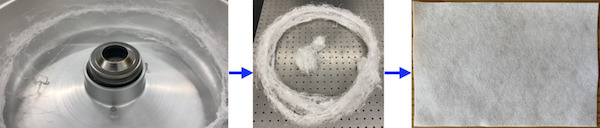
Image via M. M. Bandi (CC BY 4.0)
[via The Takeout and Good News Network, images via various sources]
Also check out these recent news


