
De-Extinction Labs Want To Bring Lost Tasmanian Tiger Back Into The Wild
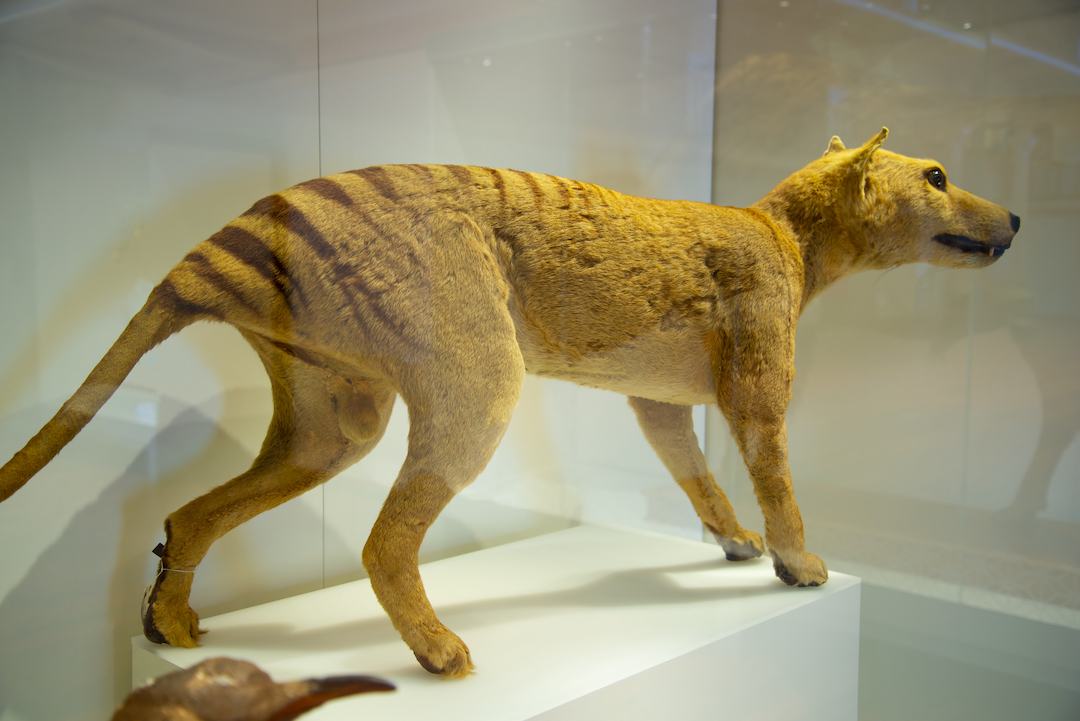
There’s an ongoing race to resurrect disappearing and lost animals in the lab. While this seems like—for the lack of a better word—a mammoth sci-fi dream, some creatures should be easier to clone.
Reconciling a similar vision to revive the extinct thylacine (affectionately known as the Tasmanian tiger due to its stripes), scientists in the US and Australia are working together in hopes to do just that, Ars Technica reports.
Unrelated to tigers, thylacines were wolf-shaped marsupials who roamed around the Australian mainland, the islands of Tasmania, and New Guinea. Although they were apex predators, they were remembered to be relatively shy creatures.
The last known thylacine, Benjamin, died in captivity in 1936. Benjamin’s kind was wiped out in a most unfortunate way; from 1888 and 1909, the Australian government handed out more than 2,000 bounties for every Tasmanian tiger hunted down and killed as it was deemed a pest and a threat to livestock back then.
Now, researchers from Colossal in Texas, which is already working to resuscitate the ancient woolly mammoth; and the University of Melbourne’s TIGRR Lab (short for Thylacine Integrated Genetic Restoration Research); are hoping to de-extinct the Tasmanian tiger and release it back into the wild by using stem cells and gene-editing technology.
If this multimillion-dollar pursuit goes well, the thylacine population could live again by the next decade.
The report points out that bringing back the thylacine would be more realistic, at least for now, than the mammoth. That’s because the marsupial had been alive until fairly recently, giving scientists much more access to museum samples and usable genomes.
The teams, led by Colossal’s Ben Lamm and the University of Melbourne’s Professor Andrew Pask, are planning to use stem cells from an existing marsupial species with similar DNA, and then alter its genes to match the thylacine’s.
Importantly, the Tasmanian tiger was an integral part of the wild, and its killing messed up the balance of the ecosystem. The same can be said about the mammoth.
By reintroducing these long-gone creatures into nature, scientists are hoping to help restore ecological balance.
[via Ars Technica and BBC, cover photo 205262352 © Adwo | Dreamstime.com]


